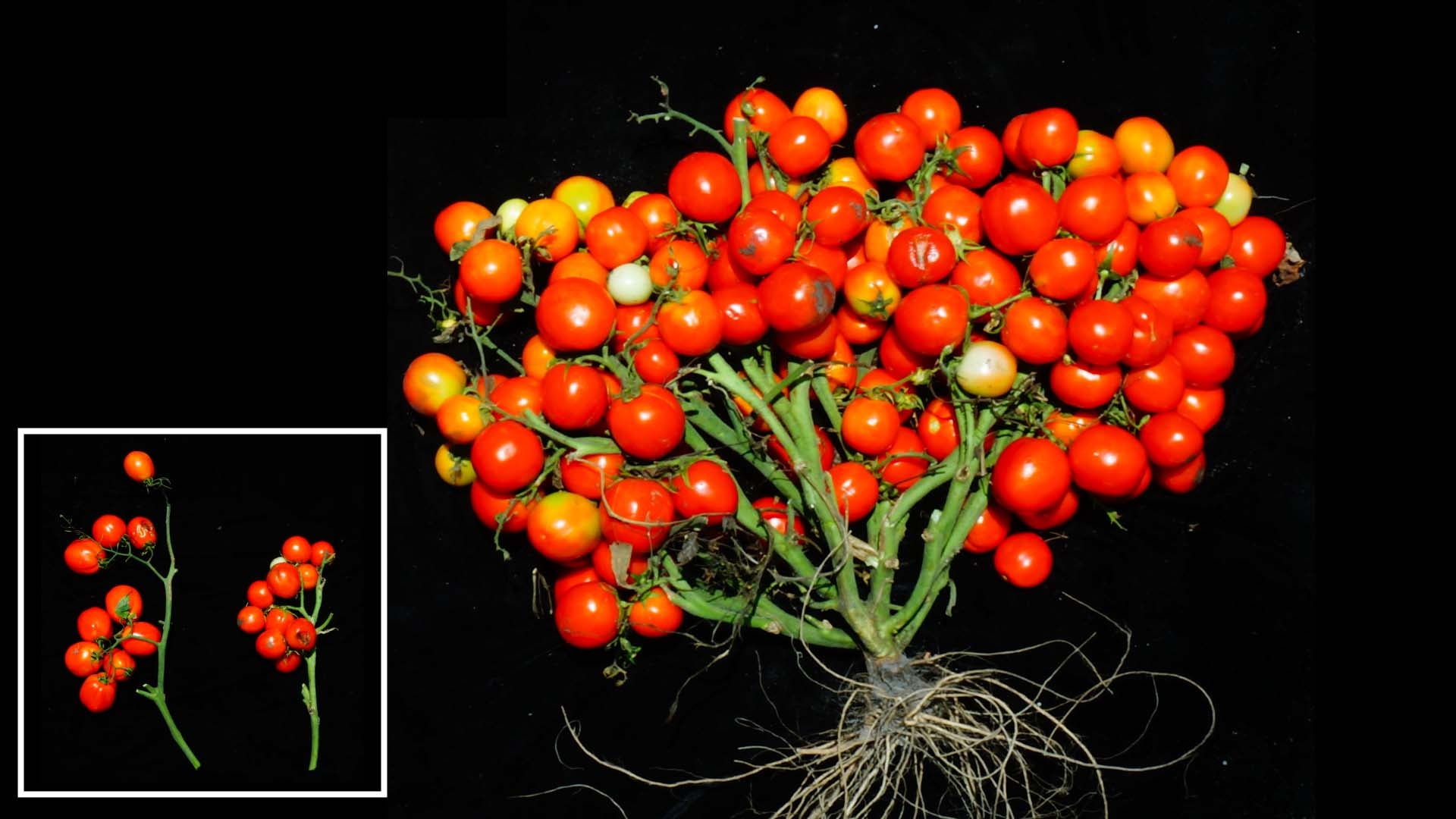
The New Tomato variety Suitable for Urban Farming and even in Outer Space developed.

image of Triple determinate mutations in tomatoes
When three specific genetic mutations are combined and tuned just right, scientists can turn tomato plants into extremely compact bushes ideal for urban agriculture. Just two of these mutations (insert, left) shortens the normally vine-like plants to grow in a field, but all three (insert, right) causes their fruits to bunch like grapes. Researchers cut away the plant’s leaves for a clearer view of the new tomatoes.

Food security, have been and will always be one of the major factor driving the socio-political geography of the world. Ensuring global food security is the second of 17 Sustainable Development Goals adopted by the United Nations as part of its 2030 Agenda for Sustainable Development but achieving this while reducing negative environmental impacts is one of the greatest challenges we will be facing. The increasing demand by the exponentially growing population is hard to be met by the arithmetically growing productions from the lands with limited productivity. Leaving the affordability of the foods aside for separate discussion, the availability of the foods is a huge problem the world is facing now and which doesn’t seem to lessen but will be prevailing even more in the near future.

The pressure to fulfill the demand-supply gap can already be seen. Farmers are using more and more of the inorganic fertilizers and the farm land has been already exploited to the extent beyond its fertility status. But this, on the one hand has created the lower quality foods that are harmful for the human body, and on the other hand it has degraded the soil quality and fertility for the coming generations. It has also impacted negatively on the environment and the ecosystems.

However in the recent times, with the advancement in genetic engineering and newer gene editing techniques like CRISPR, scientists are seen keen in developing newer varieties that are more efficient in fertilizers usage, ripens fast, uses less areas and also that yields more.

One of such latest approaches were done by the scientists in Cold Spring Harbor Laboratory (CSHL). They have developed a new variety for tomato plant that seems to be efficient for urban farming and even in outer spaces.

These new gene-edited tomato plants look nothing like the long vines you might find growing in a backyard garden or in agricultural fields. The most notable feature is their bunched, compact fruit. They resemble a bouquet whose roses have been replaced by ripe cherry tomatoes. They also mature quickly, producing ripe fruit that’s ready for harvest in under 40 days. And you can eat them.

Also the researchers claim this variety to be the eco-friendly one. “This demonstrates how we can produce crops in new ways, without having to tear up the land as much or add excessive fertilizer that runs off into rivers and streams,” Lippman said. “Here’s a complementary approach to help feed people, locally and with a reduced carbon footprint.”

This version of Tomato, ideal for farming in urban areas with limited space, is achieved by three specific genetic mutations.

Researchers have used CRISPR gene editing to optimize tomatoes for pathogene resistence and antiviral defense system.
The Second one is fine-tuning of two genes that control the switch to reproductive growth and plant size, the SELF PRUNING (SP) and SP5G genes, which caused the plant to stop growing sooner and flower and fruit earlier.
The third one is SIER gene, which controls the lengths of stems. Mutating SIER with the CRISPR gene-editing tool and combining it with the mutations in the other two flowering genes has created shorter stems and extremely compact plants.

Lippman is refining this technique, published in the latest issues of Nature Biotechnology, and hopes others will be inspired to try it on other fruit crops like kiwi. By making crops and harvests shorter, Lippman believes that agriculture can reach new heights.


This article was based on the research article published on Nature Biotechnology.
citation: ‘ Kwon et al, “Rapid customization of Solanaceae fruit crops for urban agriculture,” appeared in Nature Biotechnology on December 23, 2019. ‘

Facts about Dragon fruit

Image may contain: plant, outdoor and nature
Dragon fruit on the plant.

Dragon fruit grows on the Hylocereus cactus, also known as the Honolulu queen, whose flowers only open at night.

The plant is native to southern Mexico and Central America. Today, it is grown all over the world.

It goes by many names, including pitaya, pitahaya, and strawberry pear.

The two most common types have bright red skin with green scales that resemble a dragon — hence the name.

The most widely available variety has white pulp with black seeds, though a less common type with red pulp and black seeds exists as well.

Another variety — referred to as yellow dragon fruit — has yellow skin and white pulp with black seeds.

Dragon fruit may look exotic, but its flavors are similar to other fruits. Its taste has been described as a slightly sweet cross between a kiwi and a pear.

No photo description available.

Nutrition Facts :-
Dragon fruit contains small amounts of several nutrients. It’s also a decent source of iron, magnesium, and fiber.

Here are the nutrition facts for a serving of 3.5 ounces, or 100 grams (1Trusted Source):

Calories: 60
Protein: 1.2 grams
Fat: 0 grams
Carbs: 13 grams
Fiber: 3 grams
Vitamin C: 3% of the RDI
Iron: 4% of the RDI
Magnesium: 10% of the RDI
Given the high amount of fiber and magnesium, as well as the extremely low calorie content, dragon fruit can be considered a highly nutrient-dense fruit.
How to Eat It
Though it may look intimidating, dragon fruit is very easy to eat.

Here’s how to eat dragon fruit:-

Select a ripe fruit with bright red, evenly colored skin that gives slightly when squeezed.
Use a sharp knife and cut straight through the fruit, slicing it in half.
You can use a spoon to eat the fruit out of the skin or peel the skin off and slice the pulp into small pieces.
Ideas for serving dragon fruit:

Simply slice it up and eat it as is.
Chop it into small pieces and top with Greek yogurt and chopped nuts.
Include it in a salad.

Facts about Water chestnuts

Despite being called chestnuts, water chestnuts are not nuts at all. They are aquatic tuber vegetables that grow in marshes, ponds, paddy fields and shallow lakes .

Water chestnuts are native to Southeast Asia, Southern China, Taiwan, Australia, Africa and many islands in the Indian and Pacific oceans.

They are harvested when the corm, or bulb, turns a dark brown color.

They have a crisp, white flesh that can be enjoyed raw or cooked and are a common addition to Asian dishes such as stir-fries, chop suey, curries and salads.

However, water chestnuts (Eleocharis dulcis) should not be confused with water caltrops (Trapa natans), which are also often called water chestnuts. Water caltrops are shaped like bats or buffalo heads and taste similar to yams or potatoes.

Water chestnuts have many uses and are linked to several benefits. Here are five science-backed benefits of water chestnuts, plus ideas for how to eat them

Water chestnuts are full of nutrients. A 3.5-ounce (100-gram) serving of raw water chestnuts provides (2Trusted Source):

Calories: 97
Fat: 0.1 grams
Carbs: 23.9 grams
Fiber: 3 grams
Protein: 2 grams
Potassium: 17% of the RDI
Manganese: 17% of the RDI
Copper: 16% of the RDI
Vitamin B6: 16% of the RDI
Riboflavin: 12% of the RDI
Water chestnuts are a great source of fiber and provide 12% of the daily fiber recommendation for women and 8% for men.

commercially packaged water chestnuts

Research shows that eating plenty of fiber may help promote bowel movements, reduce blood cholesterol levels, regulate blood sugar levels and keep your gut healthy (3Trusted Source).

Additionally, most of the calories in water chestnuts come from carbs.

However, they are generally low in calories, because raw water chestnuts are 74% water.

These can be grown to maximum slow or steady rivers of terai region of Nepal , any how some districts of nepal are practicing it but yet commercial farming is too low although it have good market due to various health benefits and high.

Bees are the most important beings in the planet. Here is why.

Honey bee in the comb

Even from the beginning of human life, the human activities are constantly playing the major role in shaping the present and future of the every other living beings in the planet earth and the planet itself. The every physical and ecological changes in the planet earth are the result of the human intervention since a long period of time. Basically humans, considered as the most superior living beings, are to be blamed or to be credited for the every changes happening in the earth.

Yeah, we humans may have been the superior ones but are not definitely the most important one. A recent study conducted by the Earthwatch institute has concluded the bees to be the most important living beings on the planet.

It seems like the bees are one of the ideal kind of living beings one can dream of. Yeah its sting hurts a lot, but hey, that’s their defensive gesture. Aside of the defense, bees do no harm to the humans and the earth unlike other fatal insects. In-fact bees are the only beings proven to be free of any kinds of pathogens. That means the bees don’t carry any of the pathogens regardless of whether it is fungus, a virus or a bacteria.

Moreover the agriculture of the world depends on 70% of these insects. That means 70 out of 100 foods we feed in are intervened in favor by the bees. The bees are considered to be playing the major role in pollination and fertilization of the entomophilous plants. The flora and fauna of the planet directly depend upon the bees for their multiplication.

Presence of bees not only helps the ecological diversity and the balance flourish, they also impact largely on the various economic aspects of the society. The importance of honey, we harvest off of the honeybees’ hard work, is very well known to the masses, and this has further been the major source of income. It has also helped to establish the various industries of small scale such as honey harvesting, wax manufacturing etc. Since the beekeeping is not that much of hard work to carry out, it has also enabled the way of self-employment.

However, with the news of bees being the most important living beings on the planet and the true human companions, here comes the sad news, which hurts even more than the stings of the bees itself. According to the recent studies, Bees have already entered into the verge of extinction. Bees around the world have disappeared by around 90 percentage. The reasons for the disappearance may be different depending on the regions, but the main reasons of their disappearance are found to be excessive deforestation, lack of safe places for nests, lack of flowers, use of uncontrolled pesticides, changes in the climate and the soil conditions.

Furthermore, the waves produced due to the mobile telephony and the waves emitted during calls are to be accused of disorienting the bees causing them to lose their sense of direction and putting their life in danger. Also, Uncontrolled use of pesticides like fumigation of crops are also responsible for disappearance of the bees.

It has now been the responsibility of all of us to preserve the bees acknowledging their importance in the ecology and the well being of the planet. Some of the measures we can apply to preserve the most important living beings on the planet is to reduce using toxic pesticides, promoting natural agro alternatives, researching on the causes of their disappearance and the various other attempts for their conservation.

The Universe: How many dimensions are really possible?

We all are probably aware of the three dimensions that our daily lives revolve upon. Those that define the length, width, and depth of all the objects in our universe. (i.e. the x, y, and z axes, respectively). Beyond these three visible dimensions, scientists believe that there may be many more ruling the positions and the states of various things in our daily lives.

Albert Einstein, in his general theory of relativity, explained the concept of a four dimension universe with time being the Fourth dimension.Since, we all know that time always flows in the forward direction, The three dimensioned space and the uni dimensioned Time make up a four dimensioned Universe. That is the Universe consisting of space-time is of four dimensions.

Time is often thought of as the fourth dimension. Time plays a key role as a separate dimension in the mathematical formulations that define almost every physical laws and theories such as general relativity and string theory. However, The qualitative behavior of time as the fourth dimension is debatable.

Now, Talking about more probable dimensions which all are explained by string theory, a well known theory that is a theoretical framework in which the point-like particles of particle physics are replaced by one-dimensional objects called strings, It describes how these strings propagate through the space and interact with each other.

On distance scales larger than the string scale, a string looks just like an ordinary particle, with its mass, charge, and other properties determined by the vibrational state of the string. According to the string theory, one of the many vibrational states of the string corresponds to the Graviton. Graviton is a quantum mechanical particle that carries gravitational force. Thus, string theory is also a theory of quantum gravity.

Often marketed as one of the unsuccessful attempt of Albert Einstein, he once attempted to join and relate all the Physical forces acting on the universe by a single formulation called theory of everything.It is the theory which he could not formulate even after spending more than last 30 years of his life until eventually being dead.

However, many of the scientists today are working on the same project of confining the universe in a single mathematical formulation also called ” Theory of Everything”. The String theory could be a potential “theory of everything”, uniting all the matter and forces in a single theoretical framework, which describes the fundamental level of the universe in terms of vibrating strings rather than particles.

According to the string theory, a total of 11 dimensions are possible in the universe ( 10 of universe and 1 of time ) and each one of them is very important for the Theory of Everything.Though Scientists are applying all of their efforts and knowledge to find out all those possible dimensions, but nobody has succeeded yet. Hence based on all the scientific proofs and observations till now, we are living in the universe of only four dimensions.

Though Our basic understanding of physics makes this hard to process, string theorist Brian Greene has done a great job of framing the concepts in the terms most people can understand. In his 2005 TED Talk, Greene compares these invisible dimensions to the cables connected to telephone poles.

Quoting him, ‘From a window, a wire looks like a one-dimensional line. But if we were to study it up close we’d see that the cord is actually round, making it three-dimensional. No analogy comparing non-observable dimensions to objects in the observable world can ever be perfect, but this illustrates how something so fundamental to reality could be hiding in plain sight.’

Although from the above we can conclude that there are more than the 3 or the 4 dimensions, but the fact is that our Universe cannot have more than 11 dimensions. Because of the self consistency, they become unstable and collapse back down into 11 or 10 dimensions. Hence, there are more than four dimensions but are limited to 11.

The ted talk given by Brian Greene and referenced above is given below:

Article by: Radhakrishna Bhandari

DNA Technology: Helping farmers cope the crop diseases.

The story and the memes and the jokes of Greta Thunberg are all around the internet. The Climate change issue is being merely a joke and the minor greta is being trashed by the adults of the internet. However it is too obvious that the climate is changing constantly, but yeah not in the favor of the human race.

The climate change may not be the only cause for the declining productivity and the yeild of the crops but it surely is one of the many factors affecting the crop production. In the one hand, The Climate change has resulted in unexpected change in the normal climatic factors such as temperature and precepitation etc directly affecting the almost every biochemical and physiological processes of a plant, in the other hand it has made environment favorable for the insects, pests and viruses that has taken the form of epidemic to produce crops for the farmers all over the world.

When The farmers who feed the whole world are sleeping hungry, while on the other hand the science and the technologies are getting more uninclusive and wayy out of the reach from the farmers of the hooks and corners of the africa and the asia. The farmers are compelled to live in the poverty all their life constantly having to worry about what to ingest to get the tummy filled. The suicide rate of the farmers in India is constantly increasing and the news of the suicide are emerging more frequently.

Admist all these disappointments, Dr. Laura Boykin has come out as a sparkle of hope for some of the farmers in Saharian Africa by making the DNA technology Accessible inorder to treat the virus in their staple crop CAVASSA.

Cassava is a plant whose leaves and roots feed 800 million people globally. And 500 million in East Africa. So that’s nearly a billion people relying on this plant for their daily calories. If a small-scale family farmer has enough cassava, she can feed her family and she can sell it at the market for important things like school fees, medical expenses and savings.

But cassava is under attack in Africa. Whiteflies and viruses are devastating cassava. Several species of Whiteflies feed on the leaves of over 600 plants and transmit hundreds of plant viruses that cause cassava brown streak disease and cassava mosaic disease. This completely kills the plant.

The situation on the ground was shocking. The whiteflies had destroyed the leaves that were eaten for protein, and the viruses have destroyed the roots that were being eaten for starch.Had they known about the pests and the pathogen resistant species of the plant, the sufferings they got throughout the whole planting season could have been prevented.

However, it’s not about the non-existence of the technology we all needed,but the problem lies on the distribution of the knowledge and the technologies..The older genomic technologies that have been required to uncover the complexities in these pests and pathogens were not made for sub-Saharan Africa. They cost upwards of a million dollars and require constant power and specialized human capacity. These machines are few and far between on the continent, which is leaving many scientists battling on the front lines no choice but to send the samples overseas. And when sending the samples overseas, samples degrade and costed a lot of money and was time consuming by when it’s too late. The crop been already gone and resulting poverty and hunger.

But she knew she could fix this. In 2017, she heard of this handheld, portable DNA sequencer called an Oxford Nanopore MinION That was being used in West Africa to fight Ebola. So she thought: Why couldn’t they use this in East Africa to help farmers? At the time, the technology was very new, and many doubted if her team could replicate this on the farm. But they did it. They took the entire high-tech molecular lab to the farmers of Tanzania, Kenya and Uganda, and called it Tree Lab. So what they did was they gave themshelves a team name calling ‘The Cavassa Virus Action Project.

They made a website,and gathered support from the genomics and computing communities, and went away to the farmers. All of the molecular and computational requirements needed to diagnose sick plants is there. (which she showed in the Ted Talk here as well)


The Closer to the problem, and closer to the farmer, the quicker They could tell what was wrong with the plant and also give the solution.And the solution is, burning the field and plant varieties that are resistant to the pests and pathogens in the field. So the first thing they did was doing a DNA extraction. And using the machine called a PDQeX, which stands for “Pretty Damn Quick Extraction.”;which was given by her really cool friend Joe. One of the biggest challenges in doing a DNA extraction is it usually requires very expensive equipment, and takes hours. But with the machine they were able to do it in 20 minutes, and at a fraction of the cost. And also runs off just of a motorcycle battery.
From there, the DNA extraction was taken and prepared into a library, getting it ready to load on to the portable, handheld genomic sequencer, and then plugging this into a mini supercomputer, which is called a MinIT. And both of these things were plugged into a portable battery pack. So They were able to eliminate the requirements of main power and internet, which are two very limiting factors on a small-scale family farm. All that gluing of dead plants, and all that measuring, and all that computing finally came in handy in a real-world, real-time way. She was able to make customized databases and they were able give the farmers results in three hours versus six months.

The farmers were overjoyed. The Impact was real. Nine months after the Tree Lab, Asha, a farmer, went from having zero tons per hectare to 40 tons per hectare.
“So how do we scale Tree Lab?”, She says “The thing is, farmers are scaled already in Africa. These women work in farmer groups, so helping Asha actually helped 3,000 people in her village, because she shared the results and also the solution.”.
She further added, “I remember every single farmer I’ve ever met. Their pain and their joy is engraved in my memories. Our science is for them. Tree Lab is our best attempt to help them become more food secure. I never dream’t that the best science I would ever do in my life would be on that blanket in East Africa, with the highest-tech genomic gadgets. But our team did dream that we could give farmers answers in three hours versus six months, and then we did it. Because that’s the power of diversity and inclusion in science.”

(This article was based on a Ted-talk she had given recently. You can view it here.)

Design a site like this with WordPress.com
Get started