INTRODUCTION:
Primarily in the months of September-October, after about 90 days of sowing of kharif rice, when the panicle of the rice starts initiating and bearing seeds, a number of velvety orange masses are seen in place of panicles of some rice plants in the hot and humid region of tropical areas. That orange velvety mass is the group of chlamydospores of a fungus named Villosiclava virens(anamorph: Ustilaginoidea virens) and the phenomenon is known as the disease of false smut.
The smut pathogens belong to the order Ustilaginales, but green smut pathogen of paddy does not belong to this order. Initially it was placed under the subdivision Deuteromycotina, but later it has been placed under the subdivision Ascomycotina. So, it is not a smut in true sense, thus called false smut.
First described very early in ancient Chinese literatures (Ou, 1985), False smut was first reported in Nepal in 1985. Introduced from the Taiwanese varieties, it soon invaded most of the hybrids and even the indigenous varieties of Nepal. Later it even emerged as a pandemic in kanchan variety in Bhaktapur district resulting heavy loss in Production.
Seen during the early panicle initiation to late maturity stage of seeds, the smut results either chalkiness in the rice seed and reduces the quality or invades the whole panicle with its spores being outside surrounding the mycelia inside . The yield loss varies from one percent to the fifty percentage based on the severity of infection.
Generally, The disease affects the early flowering stage of the rice crop when the ovary is destroyed. The second stage of infection occurs when the spikelet nearly reaches maturity.
Though false smut is prevalent and visible more in panicle initiation, development or during the late maturity stages of spikelet, the infection might have been occurred during initial phases of rice. Some of those phases of false-smut-infection are :
- Intercellular systemic infection at seedling stage:
Germ tubes from conidia penetrate the cuticle of coeloptiles and grow along with the seedling. - Early flowering infection:
Here, the fungus destroys the ovary and the style of the flower but the stigmas and anther lobes remain intact and are ultimately transformed in the spore mass. - Maturing Grain infection:
The fungus spores accumulate on the glumes of the grains, absorb moisture, swell and force the lemma and palea apart. Then the spores finally come to contact with the endosperm and transform the grain into smut balls containing viable spores that can be spread for further infection.
Hence, the infestation of the fungus can be prevented on three stages if proper strategies and techniques are applied, more of which is discussed in the management section below.
IDENTIFICATION:
False Smuts are generally identified by the presence of velvety orange spore balls in the spikelets that later turn into greenish black at maturity. This structure consists of a mixture of fungal tissues and floral parts enclosed in a whitish membrane. Later on, this spherical bag bursts open and as it dries on the grains, it turns yellowish-green or greenish-black.
Only some of the spikelets are infected so we can’t see the disease in all of the spikes of the rice plant. But that does not mean the effects of the smut are limited only to the infected spikes. The spikes neighbouring the smut infected spikelet are often empty and if not empty, the grains are chaffy in nature and the quality of the grain diminishes by large extent.
Identifying the various stages during the disease cycle is also crucial for identifying weather or not the field is infected by the fungus. So here are some stages of the disease cycle in the slideshow below :

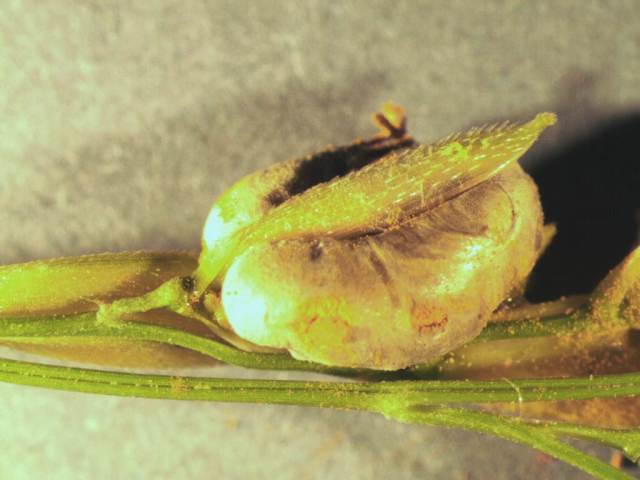


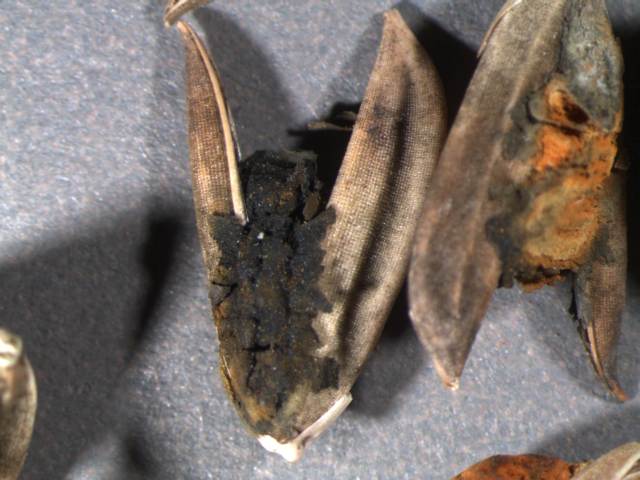
The images shown in the slideshow are chronologically:
- Spores of Stilaginoidea virens under microscopic conditions
- Very Early Symptoms:
Very early symptoms and signs of false smut infection. - Early Symptoms:
Early symptoms and signs of false smut infection.(Note silver cover over spores) - Rice Grain:
Rice grain showing false smut symptoms and signs of infection. - Severe infection:
Severe infection of rice grain by false smut. - False Smut Galls removed:
False smut galls removed by a dockage machine from rice grain. - Close Up of Rice Grain:
Up close of a rice grain replaced by a mass of false smut spores. - Darker symptoms:
Later darker symptoms and signs of false smut infection.
SOURCE OF INFECTION
Source of the disease can be accredited to various origins such as:
- Seeds: The fungus can perpetuate on seed in the form of conidia,sclerotia etc.
- Soils: The fungus can even perpetuate in soil. The Sclerotia of virins remains about 11 months under normal field conditions.
- Closely Related Host plants: Weeds liike oryzae officinale, chionache koenigii and digitaria marginata host the fungus for long.
Suitable conditions for fungal diseases:
- Hot and Humid temperature.
- Temperature (25-35 degrees Celsius.)
- Wind helps disperse the spores and increase infestation.
- Constantly irrigated or flooded low land fields.
- Constant Rainfall.
- Continuous cropping of same crop for long time without crop-rotation practices.
- Prevalence of closed related weeds of rice that may host the fungus.
- Poor crop management practices and intercultural operations.
Management:
- Alternate drying and wetting of fields.
- Clear infected plants and panicles and keep the field clean.
- Controlled irrigation.
- Practice Conservation tillage.
- Use Certified Seeds only.
- Use Diseases Resistant varieties.
- Avoid using susceptible varieties like sambha mansuli.
- Early planted rice plants usually have lower problems.
- Seed treatments: Treatment with Carbandazium @ 2 g/kg of seeds & Hot water treatment: 52 degrees for 10 minutes.
- Avoid supplying excessive nitrogen. Supply nitrogen in split doses.
- Apply copper-based fungicides as preventive measure as well as the measure for control. eg: Copper Oxychloride.
- Spraying preventively during panicle emergence with following fungicides may be effective. eg: azoxystrobin, propiconazole, chlorothalonil, trifloxystrobin, tebuconazole, @2ml/l water solely or on various combinations.
- Once infected, the further progression of disease infestation can be slowed using aureofungin, captan or mancozeb.
- Application of Bordeaux mixture(0.4%) and blitox(0.25%) from booting stage at the interval of 10 days for 3 times. (singh and singh, 1985)
Note: Relevant citations will be updated shortly.
Disclaimer: All the images used in this particular post belong to LsuAgCenter. We hereby declare no ownership of those pictures. But the rest of the text and medias are intellectual property of AgroScienceBlog and whoever does is advised not to copy paste or reproduce the content without asking for permissions priorly.
 Agro.science.blog