Food security, have been and will always be one of the major factor driving the socio-political geography of the world. Ensuring global food security is the second of 17 Sustainable Development Goals adopted by the United Nations as part of its 2030 Agenda for Sustainable Development but achieving this while reducing negative environmental impacts is one of the greatest challenges we will be facing. The increasing demand by the exponentially growing population is hard to be met by the arithmetically growing productions from the lands with limited productivity. Leaving the affordability of the foods aside for separate discussion, the availability of the foods is a huge problem the world is facing now and which doesn’t seem to lessen but will be prevailing even more in the near future.
The pressure to fulfill the demand-supply gap can already be seen. Farmers are using more and more of the inorganic fertilizers and the farm land has been already exploited to the extent beyond its fertility status. But this, on the one hand has created the lower quality foods that are harmful for the human body, and on the other hand it has degraded the soil quality and fertility for the coming generations. It has also impacted negatively on the environment and the ecosystems.
However in the recent times, with the advancement in genetic engineering and newer gene editing techniques like CRISPR, scientists are seen keen in developing newer varieties that are more efficient in fertilizers usage, ripens fast, uses less areas and also that yields more.
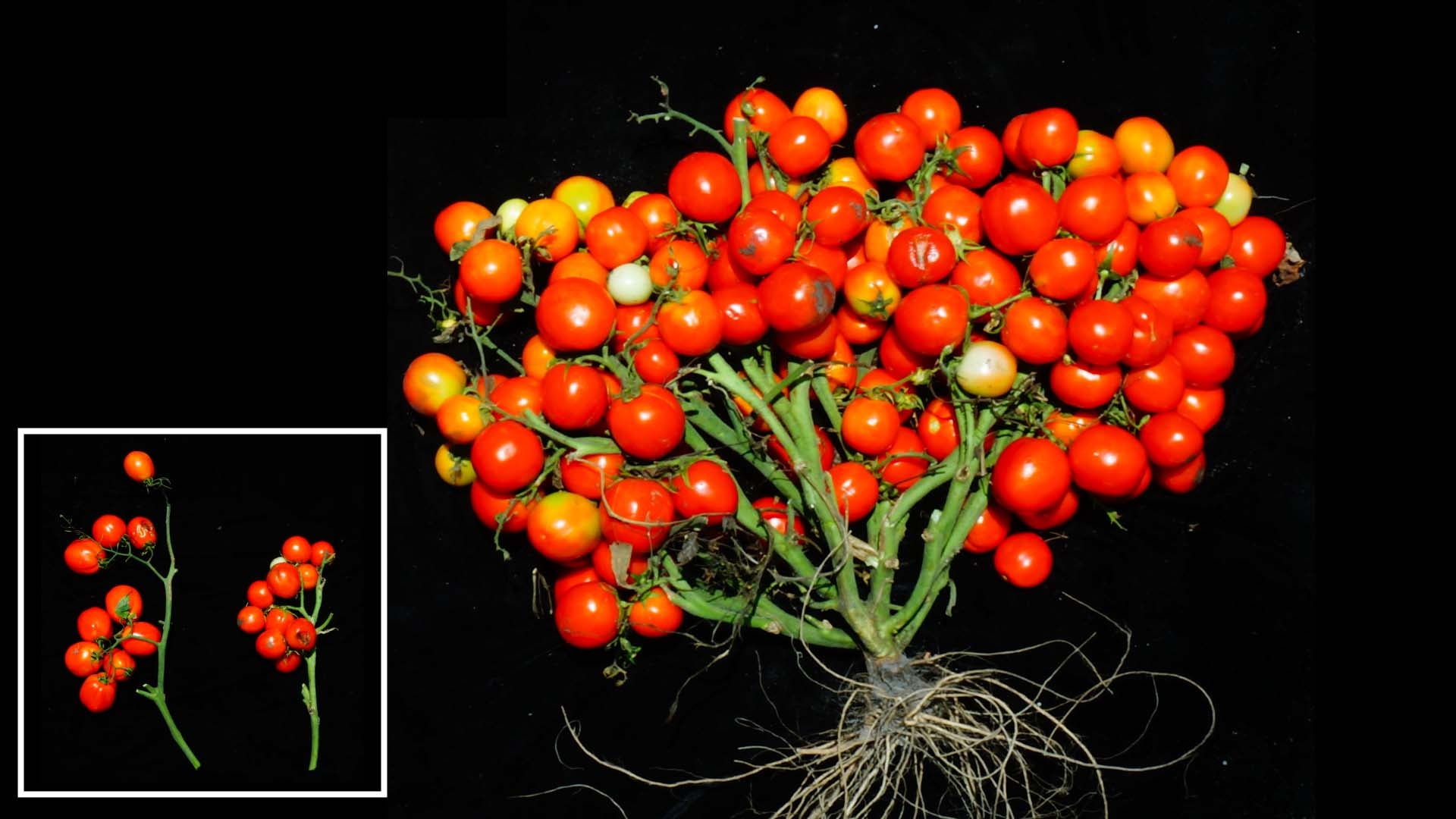
One of such latest approaches were done by the scientists in Cold Spring Harbor Laboratory (CSHL). They have developed a new variety for tomato plant that seems to be efficient for urban farming and even in outer spaces.
These new gene-edited tomato plants look nothing like the long vines you might find growing in a backyard garden or in agricultural fields. The most notable feature is their bunched, compact fruit. They resemble a bouquet whose roses have been replaced by ripe cherry tomatoes. They also mature quickly, producing ripe fruit that’s ready for harvest in under 40 days. And you can eat them.
Also the researchers claim this variety to be the eco-friendly one. “This demonstrates how we can produce crops in new ways, without having to tear up the land as much or add excessive fertilizer that runs off into rivers and streams,” Lippman said. “Here’s a complementary approach to help feed people, locally and with a reduced carbon footprint.”
This version of Tomato, ideal for farming in urban areas with limited space, is achieved by three specific genetic mutations.
Researchers have used CRISPR gene editing to optimize tomatoes for pathogene resistence and antiviral defense system.
The Second one is fine-tuning of two genes that control the switch to reproductive growth and plant size, the SELF PRUNING (SP) and SP5G genes, which caused the plant to stop growing sooner and flower and fruit earlier.
The third one is SIER gene, which controls the lengths of stems. Mutating SIER with the CRISPR gene-editing tool and combining it with the mutations in the other two flowering genes has created shorter stems and extremely compact plants.
Lippman is refining this technique, published in the latest issues of Nature Biotechnology, and hopes others will be inspired to try it on other fruit crops like kiwi. By making crops and harvests shorter, Lippman believes that agriculture can reach new heights.
This article was based on the research article published on Nature Biotechnology.
citation: ‘ Kwon et al, “Rapid customization of Solanaceae fruit crops for urban agriculture,” appeared in Nature Biotechnology on December 23, 2019. ‘
 Agro.science.blog